BOLD View
BOLD View is an tool to explore DNA barcode data. This version is based on data from BOLD_Public.06-Sep-2024.
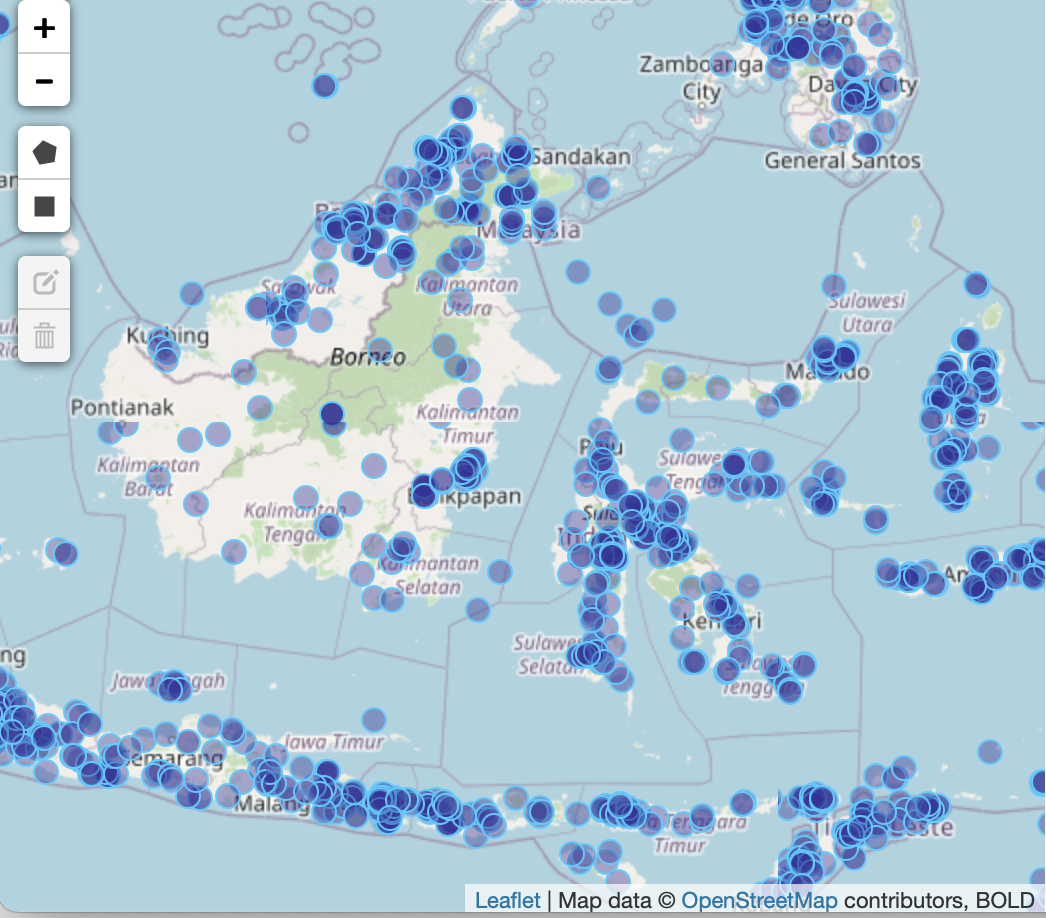
Geography
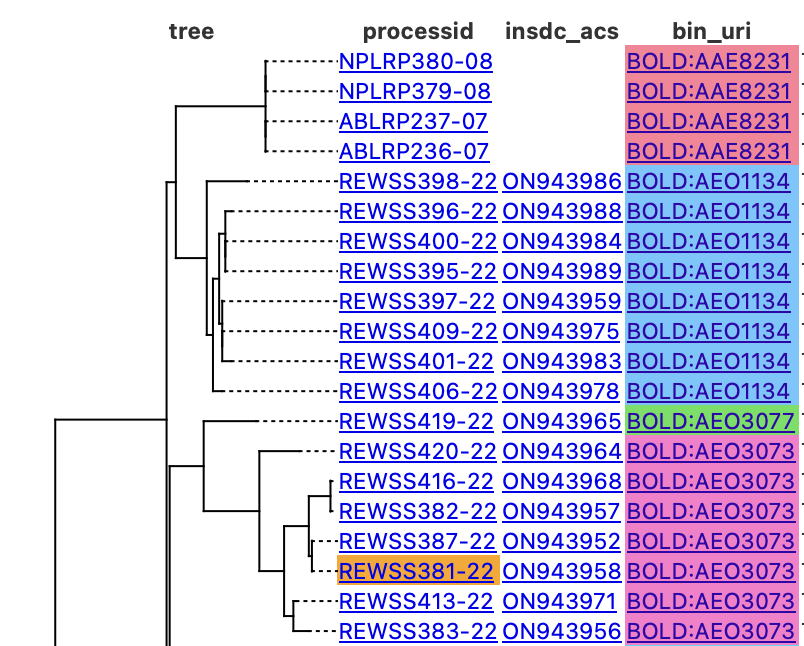
Phylogeny
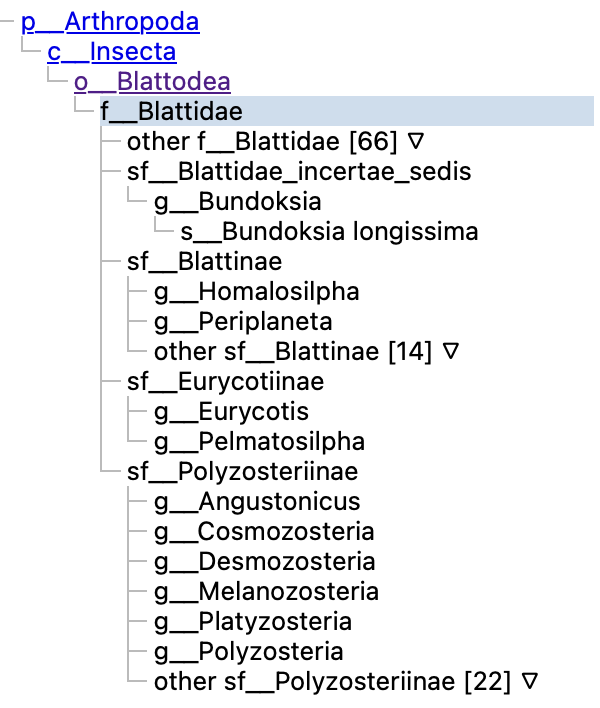
Taxonomy
Starting points
- Main features
- Barcodes
- View a barcode for a stingless bee Hypotrigona from South Africa: KMPPA063-18.
- View a barcode for a gecko Tropiocolotes tripolitanus with multiple BINs REWSS381-22
- View a barcode for a Fijian bee Homalictus nadarivatu with interesting tree GBMNC45937-20
- View a barcode (ANGBF37031-19) that is part of a BIN labelled with synonyms (Apogon smithi and Jaydia smithi), see "Exploring artificial neural networks for the curation of DNA barcode reference libraries..." doi:10.22541/au.172374899.92498971/v1.
- View a barcode (GBMNC29092-20) that is part of a clade of unnamed species of "Ariophantidae" in BOLD but we have names (see doi:10.1163/18759866-BJA10013). We also have records in GBIF from this paper via Plazi, but these contain errors and do not include accession numbers.
- View a barcode (SICOD1591-19) that has a specimen code USNMENT1566178 that is missing one digit (a leading "0") from the code for the same specimen in GBIF. GBIF does not know that this specimen has been sequenced.
- View a barcode (GBCOC12389-23) for the snake genus Sinomicrurus that is identified only as "Chordata"
- View a barcode (GACS2982-19) for a spider genus based on Genbank sequence that has subsequently been described (doi:10.54102/ajt.unvpo). Note that barcode lacks coordinates but matches GBIF record 1086173127) that does.
- View a barcode (GBMOR866-13) for a cricket endemic to New Caledonia that lacks coordinates, but specimen MNHN:ENSIF 2785 matches GBIF record 583403653) that does. See also doi:10.1371/journal.pone.0048047.
- View a barcode (GBCAA23334-24) for a Chinese cricket that lacks coordinates, but GenBank record (OP799996) has isolate number with code based on lcations in supplementary material in paper (see PMC10475508).
- View a barcode (GBMA14310-15) for a rodent that lacks full name or coordinates, but paper has both in supplementary material (see doi:10.1093/zoolinnean/zlaa040).
- View a barcode (BIPR006-13) for a Nephotettix virescens that is one example of a doubtful sequence listed in "The devil is in the details: Problems in DNA barcoding practices indicated by systematic evaluation of insect barcodes" (doi:10.3389/fevo.2023.1149839).
- View a barcode (GMAEA6199-22) for Strepsiptera (likely to be Elenchus varleyi) that is discusse din blog post (Using AI to understand a DNA barcoding mystery).
- View a bee barcode (SICOB837-18) for Nomia terminata that is in GBIF (2986797345) as Maculonomia terminata. The GBIF record doesn't mention the barcode or GenBank sequence, but the photo shows the BOLD processid. Nomia terminata is the original name for Maculonomia terminata, see Classification of the Nomiinae of the Oriental region, New Guinea and the Pacific Ocean islands (Hymenoptera: Apoidea Halictidae)
- View a collembola barcode (GBMNE18123-21 that is part of a BIN where it appears that every sequence is duplicated, where one is the BOLD record, the other is the same record in GenBank. The BOLD sequences have a scientific name, the GenBank onces do not. Species is Desoria calderonis, described in doi:10.5852/ejt.2021.787.1599.
- View a trichoptera barcode (NTSMB174-09 that has name "Smicridea R. n. sp. 18 BR" and catalogue number UMSP000088771. GenBank accession KX143199 comes from doi:10.1098/rstb.2016.0025, but species is described in doi:10.1111/aen.12417 which has table listing voucher codes and BOLD barcodes. "Smicridea R." resumably refers to Smicridea (Rhyacophylax).
- View a barcode (GBGL0272-06 for Phauda bicolor, BOLD does not have coordinates but locality is "Indonesia, ID, North Sumatra,Purba, 1 km S Seribudolok, 2o54`59``N 98o38`24``E, 1380 m, 03.02". Phauda bicolor is descrbed in Phauda bicolor sp. n. from North Sumatra (Indonesia) (Zygaenidae: Phaudinae)
- BINs
- View a BIN for ant-mimicing spiders in Borneo: BOLD:ACO6074.
- View a BIN which includes holotype (PNGTY1822-15): BOLD:ACA8529
- View a BIN with two taxonomic names, one for each sex BOLD:ACG2612 (see doi:10.54102/ajt.df83w)
- View a BIN (BOLD:AAD8883) with a messy taxonomy involving synonyms and non-synomyms.
- Taxonomy
- View taxonomy for Homalictus which Wikipedia says is not a genus.
- View taxonomy for Mabuya which Wikipedia says is a "wastebasket taxon".
- View taxonomy for Anaspidacea which are mostly found in Tasmania, but BOLD lacks this information.
- Record sets
- View recordset DS-2019PHY which lacks a DOI but is cited by "Microbiome and environment explain the absence of correlations between consumers and their diet in Bornean microsnails" (doi:10.1002/ecy.3237).
- View recordset DS-SATYP1 which comprises type specimens of saturniid moths.
- View recordset DS-PREYARMY containing army ant prey, the army ants themselves are in DS-NEOARMY, see "Hunting habits die hard: Conserved prey preferences in army ants across two distant neotropical rainforests" doi:10.1002/ecs2.4812.
- View recordset DS-ALLSAT containing lots of images of saturnids (no DOI).
- Specimen links
- View a barcode (CALI045-19) where BOLD has a specimen image but the museum specimen NHMUK013377209(the NHM) does not .
- View a barcode (GBCM19774-19) where BOLD has no species name nor coordinates, but the same specimen in GBIF 1935845318 does.
- Nomenclature
- Dicrotendipes sinicus had to be published twice, doi:10.1111/zsc.12331 and doi:10.5324/cjcr.v0i34.4079
- Congeria species published twice, doi:10.1186/1742-9994-10-5 and doi:10.20302/NC.2023.32.29
- Leurus davidwahli is not the species name, it is
- Leurus wahli published in doi:10.11646/zootaxa.5529.3.5 and named after David B. Wahl
- It looks like the same taxon of Tropiocolotes in Iran has been described using the same name by two separate research groups: Tropiocolotes hormozganensis by ROUNAGHI et al. (https://biozoojournals.ro/swjhbe/v9n1/02_swjhbe_v9n2_Rounaghi.pdf, published July 2018 according to the journal website, registered with ZooBank) and RAJABIZADEH et al. (doi:10.11646/zootaxa.4388.2.10, published 2018-03-01), see also Reptile Database. ROUNAGHI et al. also published barcode data that their description paper was partly based on: doi:10.11646/zootaxa.4303.2.4
- BIN Maps
- The BINS for sequences related to (GBMNF4584-22) form tight phylogenetic and geographic clusters, despite a recent paper concluding that they are all one species (doi:10.3897/zookeys.1106.81386).